Why Choose FRP Over Concrete for Wet Wells and Valve Chambers?
When evaluating materials for wet wells and valve chambers, Fiberglass Reinforced Plastic (FRP) provides significant performance and lifecycle advantages compared to traditional concrete construction.
1. Service Life
- FRP: FRP wet wells and valve chambers are designed for a service life of more than 100 years, maintaining structural integrity without significant deterioration.
- Concrete: Concrete wet wells often begin to degrade well before FRP due to hydrogen sulfide exposure, infiltration, and freeze-thaw cycles, requiring frequent rehabilitation or replacement. We’ve inspected concrete structures with significant degradation in less than 10 years.
2. Leak-Free Construction
- FRP: FRP structures are manufactured as one-piece, monolithic units with sealed penetrations and laminated nozzles, ensuring a completely leak-free system.
- Concrete: Concrete structures, particularly those built with segmented rings and grout joints, are prone to leaks within a few years, allowing groundwater infiltration and sewage leakage.
3. Maintenance and Cleanability
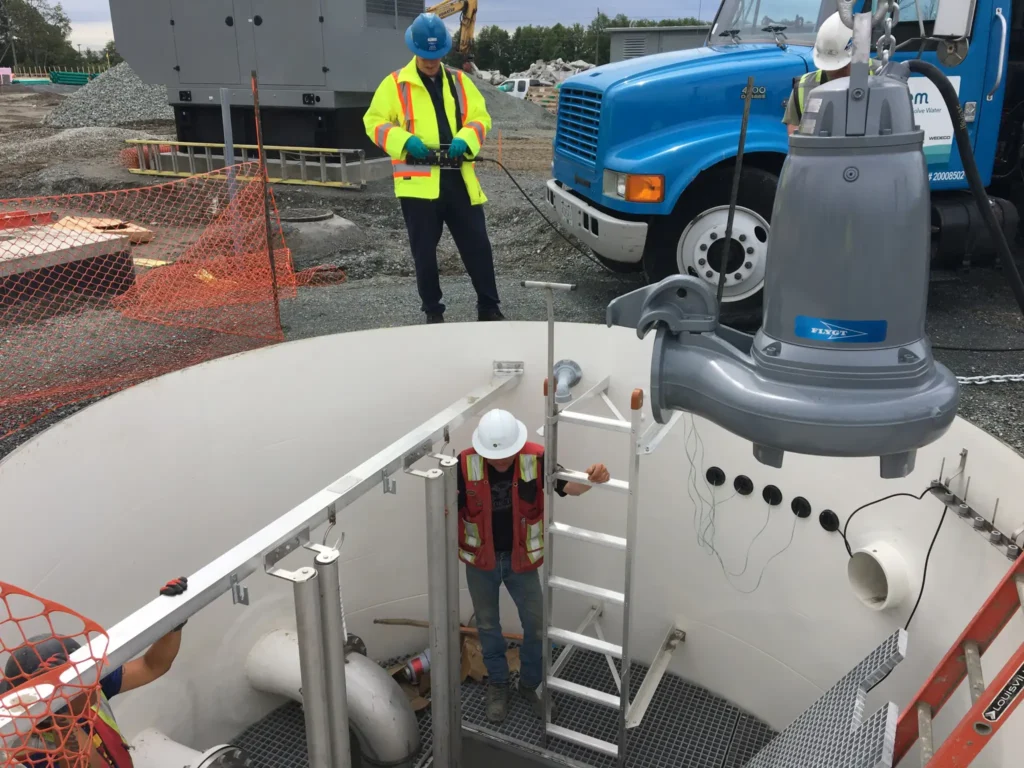
- FRP: The smooth, non-porous white interior of FRP simplifies cleaning, reduces debris accumulation, and provides high visibility with minimal lighting.
- Concrete: Concrete interiors are porous, trapping debris and microbial growth, which increases cleaning time and often requires multiple explosion-proof lights for adequate visibility.
4. Installation Time and Cost
- FRP: FRP wet wells and valve chambers arrive as prefabricated, one-piece units with internal piping and fittings already installed, allowing for installation in as little as one day with only a single truck delivery.
- Concrete: Concrete wet wells are constructed on site, typically taking 8-12 weeks, requiring multiple trades, extensive dewatering, and numerous truckloads of materials and equipment.
5. Corrosion and Environmental Resistance
- FRP: FRP is resistant to hydrogen sulfide gas, leachate, and other aggressive chemicals, and its sealed design makes it well suited for high groundwater environments.
- Concrete: Even with epoxy or PVC liners, concrete remains vulnerable to cracking, spalling, and liner delamination, which eventually allows infiltration and accelerates structural deterioration.
6. Structural Capacity and Flexibility
- FRP: FRP tanks are engineered to handle full hydrostatic loads and can be designed with H-20 traffic-rated tops or integrated above- and below-ground valve chambers to reduce confined space entry.
- Concrete: Concrete structures must be formed and poured on site and lack the flexibility of integrated prefabricated chambers, resulting in longer construction times and larger site footprints.
7. Confined Space Entry
- FRP: FRP stations can incorporate above-ground or side-mounted valve chambers that allow operators to perform maintenance without entering confined spaces.
- Concrete: Concrete stations typically require below-ground access for valve maintenance, increasing the frequency of confined space entry.
8. Warranty and Quality Assurance
- FRP: Barski FRP products are covered by a 25-year warranty and can be factory-tested under hydrostatic pressure before delivery to confirm leak-free performance.
- Concrete: Concrete wet wells are generally covered by a one-year warranty and require all leak testing to be performed after on-site construction, which can introduce delays.
Conclusion
FRP wet wells and valve chambers provide longer service life, leak-free operation, faster installation, and lower maintenance compared to concrete. For municipalities and industries seeking durable, corrosion-resistant, and cost-effective infrastructure, FRP offers a proven and technically reliable solution.